

Your first Shockwave appointment: What it feels like, and who it isn't for.
If you're wondering whether Shockwave therapy hurts, and whether it's right for you, you're asking the same two questions almost everyone asks before they book. This is an honest walk-through of a first visit to our clinic in Highams Park: what it usually feels like, what happens afterwards, and who it isn't for.

I'm Rich Pearson and I, with my wife Cher, am a Clinic Director at The Shockwave Therapy Clinic at 102 Larkshall Crescent, Highams Park, London E4 6NS.
Between us we have over 25 years' combined experience and only the two of us treat patients here at The Shockwave Therapy clinic — we do not employ staff or locums, so we are able to give you professional and personal 1 - 1 care that is tailored to your individual needs, at our warm and friendly clinic. Both Rich and Cher treat musculoskeletal (MSK) problems with Radial and Focused shockwave. We hold Venn Healthcare certificates, and we use Storz Medical equipment, including the Storz Medical DUOLITH SD1 T-Top focused device.
Before you arrive.
You don't need a GP referral. Almost all of our patients book directly, and we can usually see people within 2 to 3 days. Call Rich: 07807 333469, message us on WhatsApp, or use our contact page. We're open Monday to Friday 9am to 6pm and Saturday 9am to 1pm (closed Sunday).

Getting here is straightforward. We're about a 5-minute walk from Highams Park station on the Shell garage side of the tracks, about 8 minutes from the other side of the level crossing, and about 10 minutes from the 275 bus stop.
There is free parking on the drive outside the clinic, plus free street parking opposite.
We offer free on-site parking at The Shockwave Therapy Clinic, in Highams Park.
We advise that patients should wear comfortable clothes that can be rolled up or loosened, so we can reach the problematic area. Bring any scan reports or letters you already have. Tell us about every medicine and supplement you take, including blood thinners and any recent steroid injections.
What happens in the room?
Your first session includes an assessment: how the problem started, what makes it better or worse, and what you've already tried. That assessment isn't charged separately. We'll also check whether Shockwave is suitable for you that day. If it isn't, we'll say so.
Storz focused shockwave device at The Shockwave Therapy Clinic, Highams Park.
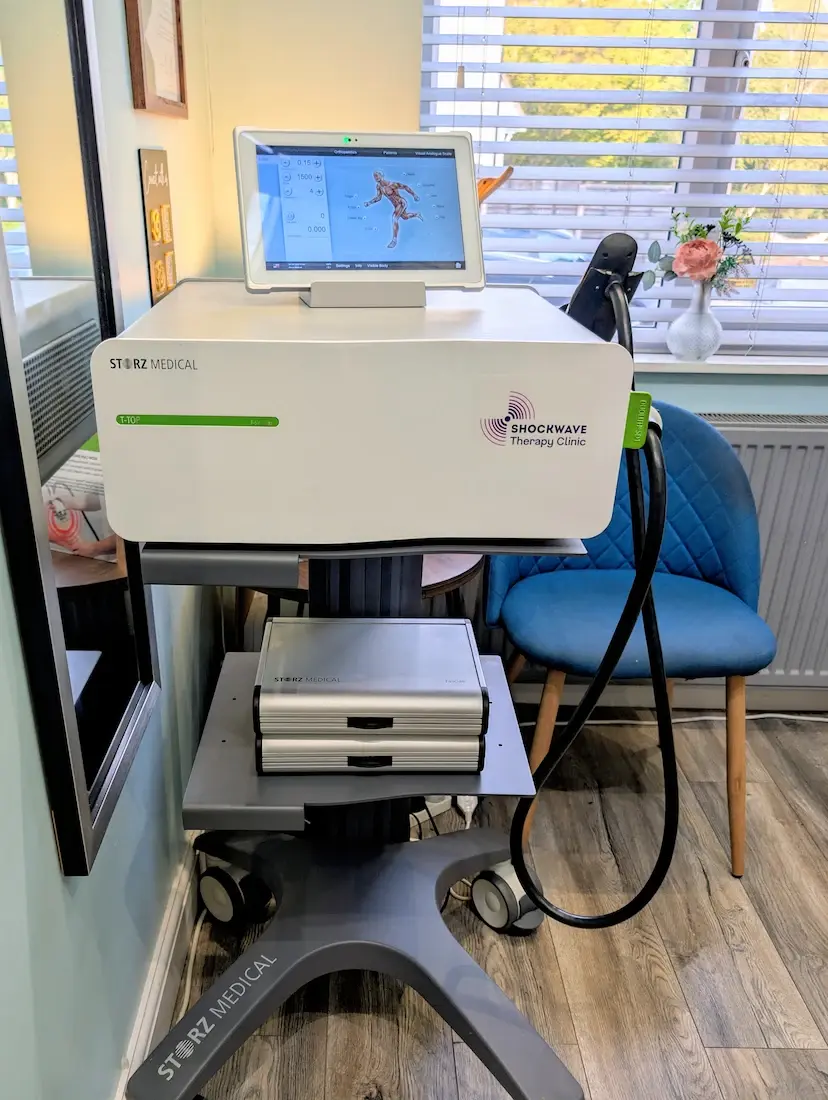
We use a coupling gel on the skin, then apply the handpiece. We have both focused shockwave on our Storz Medical DUOLITH T-Top, and Radial Shockwave on our Storz MASTERPULS MP200. Focused shockwave is true shockwave.
Radial is a pressure wave, a different treatment, and the two are often used together in one session. Focused energy reaches a smaller, deeper target; radial spreads more widely near the surface. You can read more in our guide to radial versus focused shockwave and on our focused shockwave therapy page.
A typical MSK session lasts about 25 minutes for one problematic area, or 45 to 50 minutes for two areas. We start at a comfortable intensity and adjust as we go. Tell us straight away if anything feels too sharp — the setting is under your control as much as ours.
What it usually feels like
Shockwave is not "pain-free", and we won't pretend it is. Most people describe a rapid tapping, buzzing or deep pressure over the sore spot. On bony or very tender areas it can feel sharper.
Reviews of extracorporeal shockwave therapy (ESWT) note that discomfort during treatment is common, and that short-lived redness or minor bruising can follow.
A 2020 update in EFORT Open Reviews by Auersperg and Trieb describes ESWT as generally well tolerated when used as recommended, with known short-term effects such as pain during treatment and minor haematomata (small bruises), rather than severe complications when contraindications are respected. We build intensity gradually, and we pause or turn it down if you need us to.
Afterwards the area can feel warm, flushed or a bit "worked". Side effects are usually mild and short-lived, such as redness, tenderness or occasionally bruising. Some people feel a little light-headed during or just after treatment; if that happens, we get you to sit or lie down until it passes. Results vary from person to person, and we can't promise a particular outcome.
Afterwards and between sessions
You can usually go back to normal day-to-day activity the same day, though we may ask you to ease off the movement that aggravates the problem for a short while. Some people feel a temporary increase in ache for a day or two before it settles. It's important not to take anti-inflammatory painkillers such as ibuprofen, or use ice on the treated area, during your course of treatment and for about 10 weeks after your last session.
Shockwave therapy works by triggering your body's own healing response, and anti-inflammatories may reduce that effect. If you need pain relief, paracetamol is fine to take, as long as you follow the dose on the pack.
Please don't stop any medicine you've been prescribed without talking to your GP. If pain is severe, getting worse, or you notice spreading redness, heat or fever, contact us or your GP.
MSK sessions are usually 5 to 10 days apart (7 days is typical). A course is usually 3 to 6 sessions — around 3 on average, and sometimes only 1 or 2 for more recent injuries. For stubborn lower-limb tendon problems, a 2018 systematic review in the British Journal of Sports Medicine (Korakakis and colleagues) found low- to moderate-level evidence that ESWT may help some conditions, with results that vary by diagnosis and study quality. We talk that through in plain English before you commit to a course.
For everyday soft-tissue injuries, the NHS advice on sprains and strains and on tendonitis is still a good baseline: protect the area, and seek medical help if you can't put weight on a limb, have severe swelling, numbness, or the injury isn't improving. Shockwave sits alongside that kind of care — it doesn't replace a proper check when something is acute or unclear.
Who it isn't for.
Shockwave isn't suitable for everyone. Drawing on the contraindications summarised by Auersperg and Trieb (2020), and on how we work in clinic, we would not treat you with shockwave — and we may ask you to speak to your doctor — if any of the following apply:
You are pregnant, or there is any chance the treatment field could include a foetus or embryo.
There is a severe infection in or near the area we would treat.
You have cancer or a tumour in or near the area to be treated.
You have a severe blood-clotting disorder (coagulopathy). If you take anticoagulant (blood-thinning) medicines, tell us before booking so we can decide with you — and your GP if needed — whether treatment is appropriate.
The treatment field would include the lungs. Shock waves must not be aimed where lung tissue sits in the sound field, because that can cause serious injury.
You have had a steroid (cortisone) injection in the area within the last 6 weeks. Our clinic rule is that we must not give shockwave until at least 6 weeks after a steroid injection.
Children under 12. We can treat young people aged 12 and over, as long as a parent or guardian comes with them. Rich and Cher will check at your assessment whether treatment is suitable, and avoid treating directly over growing areas of bone (growth plates).
Metal implants near the treatment field also need a careful chat — shock waves interact differently with materials of very different density — so bring details of any plates, screws or joint replacements. If you're unsure about any of the above, say so when you book; it's better to delay a session than to push on when it isn't right.
When to see your doctor instead
Some symptoms need checking by your doctor rather than treating with shockwave. Please speak to your GP if you have red-flag symptoms, for example:
Sudden severe pain after a fall or twist, or you can't weight-bear
A hot, red, swollen joint with fever
Unexplained weight loss, night pain that wakes you, or a history of cancer with new bone pain
New numbness, tingling or weakness in a limb
We're happy to work alongside your GP and any other clinicians involved in your care. We never ask you to stop prescribed treatment without speaking to the person who prescribed it.
Ready to book a first visit?
If your symptoms fit and none of the exclusions above apply, a first session is a proper assessment plus treatment if it's appropriate that day. Our Highams Park page explains more about shockwave therapy at the clinic, and current package options are on our treatment prices page (a single focused session is £130, three for £350, or six for £675).
There are no hidden fees, and we are not VAT-registered so no VAT is added.
Message Rich on WhatsApp, call 07807 333469, or use the contact page.
We're at 102 Larkshall Crescent, Highams Park, London E4 6NS — a short walk from the station, with free parking on the drive.
We've had 100 five-star Google reviews from people who've already sat in that chair and asked the same question you're asking now.
Sources
This article is general information, not medical advice. Results vary from person to person. If you're unsure whether shockwave is suitable, ask us, or speak to your doctor, before booking.


Comments